In January 2026, a major cloud transcription service disclosed that 14 million audio files - including medical dictations, legal depositions, and corporate meeting recordings - had been accessible to unauthorized parties for at least seven months. The company described it as a "configuration error."
Fourteen million audio files. Seven months. A configuration error.
This was not the first incident of its kind. It will not be the last. And it illustrates something that the voice technology industry has been quietly hoping you would not notice: the way most voice tools handle your data is fundamentally broken. Not because the companies are malicious, but because the architecture they chose - sending your audio to the cloud - creates risks that no privacy policy can fully address.
This article is a snapshot of where voice data privacy stands in 2026. The breaches. The regulations. The gap between what companies promise and what their architecture allows. And what you can do about it.
The Breach Landscape
Voice data breaches have grown in both frequency and scale over the past three years. Here are some of the incidents that have shaped the current landscape.
Recent Notable Incidents
Cloud Transcription Services: Multiple transcription providers have experienced breaches exposing customer audio. The data typically includes not just transcribed text but raw audio files - meaning the victims' actual voices, with all the biometric information that carries.
Voice Assistant Recordings: Major tech companies have faced lawsuits and regulatory action for retaining voice assistant recordings longer than disclosed, sharing them with contractors for "quality assurance," and using them to train AI models without explicit consent.
Meeting Recording Tools: The explosion of remote work created a market for meeting transcription services, many of which store recordings on cloud infrastructure. Several have been breached, exposing confidential business discussions, client meetings, and internal strategy sessions.
Healthcare Dictation: Medical dictation systems that route audio through cloud servers have been implicated in healthcare data breaches. When a doctor dictates patient notes through a cloud service, that audio potentially contains protected health information (PHI) - making any breach a HIPAA violation with severe penalties.
Why Voice Breaches Are Different
When a database of passwords is breached, you change your passwords. When credit card numbers are stolen, you cancel the cards. These are recoverable events.
When voice data is breached, there is no recovery. Your voice is a permanent biometric identifier. You cannot change the shape of your vocal tract. You cannot alter your speech patterns fundamentally enough to defeat voiceprint matching. A single high-quality recording of your voice can be used for:
- Identity theft - voice cloning tools can now produce convincing replicas from minutes of sample audio
- Biometric bypass - systems that use voice verification (banking, security) become vulnerable
- Deepfake creation - audio deepfakes using your voice can be generated for fraud or manipulation
- Behavioral profiling - your voice reveals emotional state, stress levels, and health indicators
We covered the full scope of what your voice reveals in our earlier article on why voice data is more sensitive than you think. The regulatory landscape has only made those concerns more urgent.
The Regulatory Landscape in 2026
Governments around the world are catching up to the reality of voice data risks, though the regulatory patchwork remains uneven.
GDPR (European Union)
The General Data Protection Regulation treats voice recordings as personal data and, when used for identification, as biometric data subject to stricter protections under Article 9. In practice, this means:
- Voice data requires explicit consent for collection and processing
- Users have the right to access, correct, and delete their voice data
- Data processors must demonstrate a lawful basis for processing
- Breaches must be reported to authorities within 72 hours
The EU AI Act, which took full effect in 2025, goes further. It classifies biometric identification systems - including those that use voiceprint matching - as "high-risk," imposing mandatory risk assessments, transparency requirements, and human oversight obligations.
For companies processing European users' voice data, the compliance burden is substantial. For users, the protections are meaningful but depend on enforcement.
CCPA / CPRA (California)
The California Consumer Privacy Act, as amended by the California Privacy Rights Act, gives residents the right to:
- Know what voice data is collected about them
- Delete their voice data
- Opt out of the sale or sharing of their voice data
- Limit the use of sensitive personal information (which includes biometric data)
California's definition of "biometric data" explicitly includes voiceprints and voice recordings used for identification. Companies that collect voice data from California residents must disclose this in their privacy notices and honor deletion requests.
BIPA (Illinois)
Illinois' Biometric Information Privacy Act remains the most aggressive biometric privacy law in the United States. It requires:
- Written consent before collecting biometric data (including voiceprints)
- A published retention and destruction schedule
- Prohibition against profiting from biometric data
BIPA includes a private right of action, meaning individuals can sue directly - not just through regulators. This has led to multi-million dollar settlements against companies that collected voice data without proper consent, including Fireflies.AI and others.
HIPAA (United States)
For healthcare, HIPAA's privacy and security rules govern voice data that constitutes protected health information. When a doctor dictates patient notes, that audio is PHI. When a therapy session is transcribed, that transcript is PHI. When a telehealth consultation is recorded, that recording is PHI.
Cloud-based voice processing of healthcare data requires:
- A Business Associate Agreement (BAA) with the processing service
- Encryption in transit and at rest
- Access controls and audit logging
- Breach notification within 60 days
The penalties for HIPAA violations involving voice data can reach $1.5 million per violation category, per year. For healthcare organizations, the risk of sending patient voice data to cloud services is not just a privacy concern - it is a financial one.
Emerging Regulations
Several other jurisdictions are developing or have recently enacted voice data protections:
- Brazil's LGPD treats voice as sensitive personal data requiring specific consent
- India's DPDP Act includes provisions for biometric data protection
- Several US states (Texas, Washington, Colorado) have enacted or are considering biometric privacy laws modeled on BIPA
The trend is clear: regulation is tightening. Companies that built their products around cloud-based voice processing are facing increasing compliance costs and legal exposure. The simplest way to avoid these risks is to never collect the data in the first place.
How Cloud Voice Tools Handle Your Data
Understanding how your voice data flows through cloud-based tools helps clarify why local processing matters.
The Typical Cloud Architecture
When you use a cloud-based dictation or transcription service, the following typically happens:
- Capture: Your device records audio through the microphone
- Compression: The audio is compressed (losing some quality but reducing file size)
- Transmission: The compressed audio is sent over the internet to a remote server
- Processing: The server runs speech recognition models on your audio
- Storage: The audio and/or transcription may be stored temporarily or indefinitely
- Training: Your audio may be used to improve the service's models
- Response: The transcription is sent back to your device
Steps 3 through 6 are where the risks live. Each one creates an exposure point.
What "Temporary Storage" Really Means
Many services claim they "temporarily" store audio for processing and delete it afterward. But "temporary" is loosely defined. In practice:
- Audio may be cached on multiple servers during processing
- Backup systems may retain copies for disaster recovery
- Logging systems may capture metadata about the audio
- Training pipelines may extract features from the audio before it is "deleted"
- "Deletion" from the primary database does not guarantee deletion from backups, caches, and downstream systems
When a service says "we delete your audio after processing," they usually mean "we delete it from the primary processing queue." Whether it persists in backups, training datasets, or logging systems is a separate question - one that most privacy policies do not clearly answer.
The Training Data Problem
Machine learning models get better with more data. Cloud-based speech recognition services have a strong incentive to use customer audio for model training, because more diverse training data produces more accurate models.
Some services are upfront about this. Others bury it in terms of service. A few have been caught doing it without disclosure.
The key question to ask any cloud voice service: "Is my audio used, in any form, to train or improve your models?" If the answer is yes, your voice - your biometric identifier - is being incorporated into a system that will persist indefinitely and potentially be accessible to the company's employees, partners, and eventual acquirers.
Audio transmitted to servers. Stored temporarily (or indefinitely). Potentially used for model training. Subject to breaches, subpoenas, and third-party access. Your voiceprint exists on infrastructure you do not control.
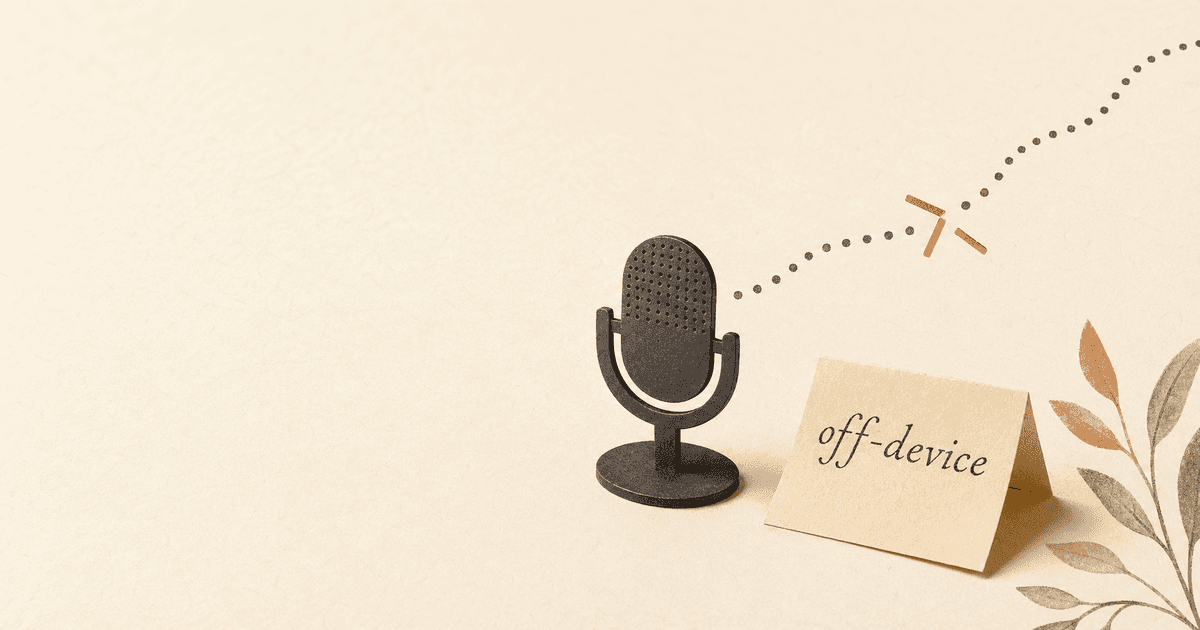
Audio stays on your machine. Processed by local hardware. Never transmitted. Never stored externally. No training pipeline. No exposure surface. Your voiceprint exists only on your device.
Practical Steps to Protect Your Voice Data
You do not need to wait for regulation to catch up. Here is what you can do right now.
Audit Your Tools
Open System Settings > Privacy & Security > Microphone on your Mac. Look at every app that has microphone access. For each one, ask:
- Do I actually use this app's voice features?
- Does it process audio locally or in the cloud?
- What does its privacy policy say about voice data retention and training?
Revoke microphone access for anything that does not need it. This takes five minutes and immediately reduces your exposure.
Switch to On-Device Tools
For your primary voice workflows - dictation, text-to-speech, voice notes - choose tools that process everything locally. The accuracy gap between cloud and on-device has closed to the point where most users will not notice a difference in daily use. For a detailed look at making the switch, see our complete guide to offline dictation.
The privacy difference, however, is absolute. On-device processing means your audio never leaves your machine. No amount of privacy policy language can match the security of data that simply does not exist on any external server.
Be Cautious with Meeting Recordings
Meeting transcription services are one of the largest sources of sensitive voice data exposure. Before recording any meeting, consider:
- Does the transcription happen locally or in the cloud?
- Are all participants aware they are being recorded?
- Does the content of the meeting warrant the risk of cloud transmission?
- What happens to the recording after transcription?
For meetings involving confidential business information, client discussions, or legally sensitive topics, local transcription is the only approach that eliminates the risk of external exposure. We cover this in detail in our article on meeting transcription without the cloud.
Read the Privacy Policy (Really)
Not the marketing page. The actual privacy policy. Look for specific language about:
- Whether audio is transmitted to servers
- How long audio is retained
- Whether audio is used for model training
- Whether audio is shared with third parties
- What happens to your data if the company is acquired
If the policy is vague on any of these points, assume the worst. Companies that handle data responsibly are specific about how they handle data.
Review Regularly
Voice tools change. Privacy policies change. New features may introduce cloud dependencies that did not exist when you signed up. Set a quarterly reminder to review your voice tool permissions and privacy settings.
The Direction Things Are Moving
The voice data privacy landscape is shifting in two directions simultaneously.
On one side, regulation is tightening. More jurisdictions are classifying voice as biometric data. Penalties for mishandling biometric data are increasing. The cost of cloud-based voice data collection is rising.
On the other side, on-device processing is becoming more capable. Apple's Neural Engine gets more powerful with each chip generation. On-device speech recognition models are approaching cloud accuracy for most use cases. The technical argument for cloud processing - "we need server-grade hardware for good accuracy" - is no longer true.
These two trends converge on the same conclusion: the future of voice processing is local. Not because local is a nice option, but because it is the only architecture that satisfies both user privacy expectations and regulatory requirements without ongoing compliance overhead.
How Yaps Fits In
Yaps was designed for exactly this moment. As a privacy-first voice assistant, every feature - speech-to-text, text-to-speech, voice notes, studio editor, voice commands, smart history - processes audio on your Mac using the Neural Engine. No cloud APIs. No server infrastructure. No data transmission.
This is not a privacy setting you need to find and enable. It is the architecture. Yaps has no mechanism to send your voice anywhere, because it was never built to.
No user accounts. No analytics on speech content. No training pipeline. No Business Associate Agreement needed, because there is no business associate - your data never reaches us.
For professionals in regulated industries - healthcare, legal, financial services - this architecture simplifies compliance. There is no cloud processor to evaluate, no BAA to negotiate, no data flow to document. The voice data stays on the device. The audit trail is simple.
For everyone else, it means one less thing to worry about. Your voice, your words, your thoughts - they stay where they belong. With you.
A voice keyboard that keeps your voice on your phone.
Install Yaps on Android for offline dictation, a familiar full-size keyboard, and no screen capture. Scan the QR on desktop, or tap the Play badge on mobile.
Frequently Asked Questions
Is voice data more sensitive than text data?
Yes. Voice data contains biometric information that text does not - your vocal tract shape, speech patterns, accent, emotional state, and health indicators are all encoded in audio. Unlike a password or credit card number, you cannot change your voice after a breach. A single recording can be used for identity theft, deepfake creation, and biometric bypass attacks, making voice data fundamentally more sensitive than most other personal data types.
Do voice assistants record everything I say?
Most cloud-based voice assistants activate when they detect a wake word, but research and lawsuits have shown that recordings are often captured outside of intentional activation. Several major tech companies have confirmed that human contractors reviewed voice assistant recordings as part of quality assurance. The only way to guarantee your voice is not being recorded and stored is to use an on-device assistant that has no mechanism to transmit audio to external servers.
How can I protect my voice data in 2026?
Start by auditing which apps have microphone access on your Mac under System Settings > Privacy & Security > Microphone. Revoke access for anything you do not actively use. For your primary voice workflows, switch to tools that process audio entirely on-device rather than in the cloud. Read the actual privacy policies of any voice tools you use and look specifically for language about audio retention, model training, and third-party sharing.
What regulations protect voice data?
Several major regulations now cover voice data. GDPR in the EU treats voice recordings as personal data and potentially biometric data under Article 9. Illinois' BIPA requires written consent before collecting voiceprints and allows individuals to sue directly. HIPAA governs voice data containing protected health information in healthcare. California's CCPA/CPRA gives residents the right to delete voice data and opt out of its sale. The trend across jurisdictions is toward stricter classification and heavier penalties.
Can my voice be cloned from a recording?
Yes. Modern voice cloning technology can produce convincing replicas from just a few minutes of sample audio. Once your voice is cloned, the synthetic version can be used for fraud, impersonation, and social engineering attacks. This is one of the reasons voice data breaches are considered more severe than many other types of data breaches - the exposed biometric information enables new categories of harm that did not exist a few years ago.
What is the difference between cloud and on-device voice processing?
Cloud voice processing captures your audio, compresses it, sends it over the internet to a remote server for recognition, and returns the text. Your audio exists on infrastructure you do not control and may be stored, used for model training, or exposed in a breach. On-device processing runs the speech recognition model directly on your computer's hardware. The audio never leaves your machine, never crosses a network, and never exists on any external server. The privacy difference is structural and absolute.
Is on-device speech recognition accurate enough to replace cloud processing?
For most use cases, yes. On-device models running on Apple Silicon now achieve word error rates within 2 to 3 percentage points of the best cloud systems. For standard dictation - emails, documents, notes, messages - the accuracy gap has closed to the point where most users will not notice a difference. Cloud models still have a slight edge in noisy multi-speaker environments and with highly specialized vocabulary, but for typical voice workflows, on-device accuracy is more than sufficient.
What happens to my voice data if a company is acquired?
When a company is acquired, its data assets - including any voice recordings, transcriptions, and voiceprints it has collected - typically transfer to the acquiring company. The new owner may have different privacy policies, different security practices, and different intentions for the data. This is a risk that most users do not consider when they agree to a privacy policy, and it is another reason why on-device processing, where no voice data is ever collected by a company, eliminates an entire category of long-term risk.
Voice data privacy in 2026 is not a theoretical debate. It is a practical reality shaped by real breaches, real regulations, and real consequences. The simplest, most effective thing you can do is choose tools that keep your voice on your device.
Your voice is the most personal data you produce. Treat it accordingly.